
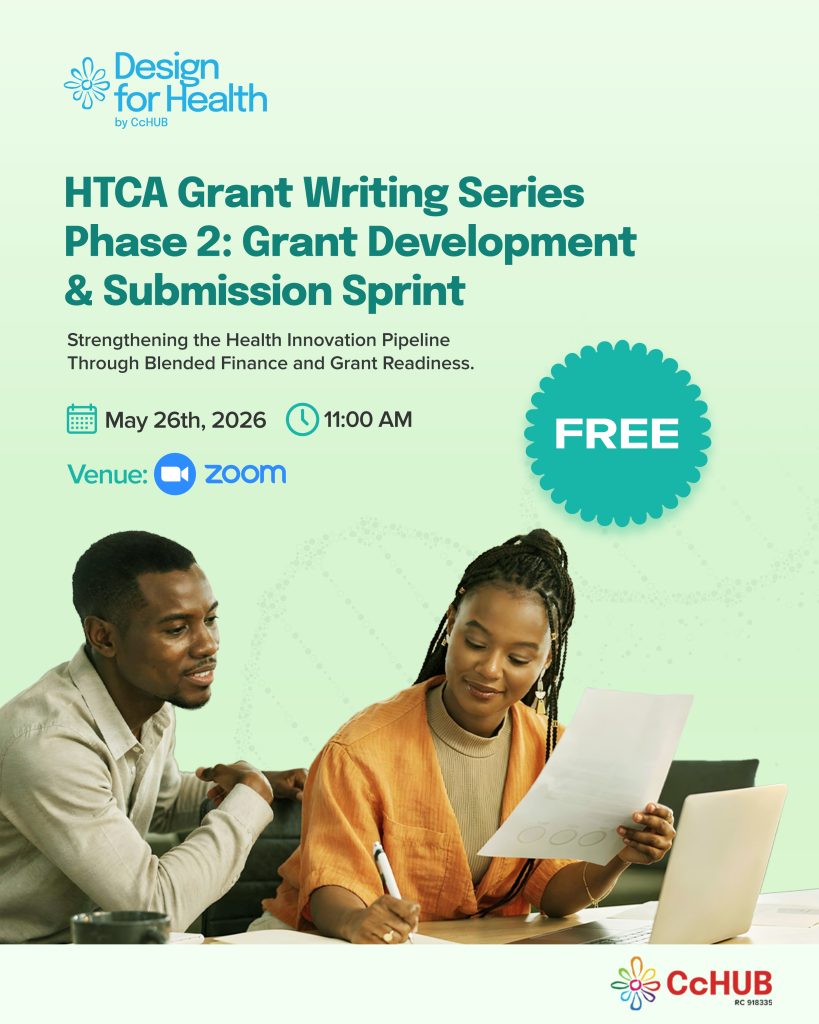
Event Type: Two-phase, outcome-driven capacity-building series
Format: Hybrid (Virtual + Limited Physical Attendance)
Venue
- Virtual: Zoom
- Physical: Relearn Towers, 8 Montgomery Road, Yaba
Dates:
- Phase 1: April 30
- Phase 2: May 26th
The HTCA Grant Writing Lab Series is a structured, hands-on strategic intervention in the healthtech financing pipeline. Targeted at both early- and growth-stage founders, Phase 1 is an interactive grant-writing lab designed to move participants from basic awareness to informed action. The session provides a clear understanding of funding pathways, including grants and broader financing funnels, while offering direct exposure to institutional perspectives.
Participants will engage with funders and ecosystem experts to understand what strong applications look like, how funding decisions are made, and whether their startup or organisation is realistically positioned to apply.
Speakers and Facilitator
Bertrand Pedersen
Private Sector Partnerships & Innovations Manager, Gavi, the Vaccine Alliance
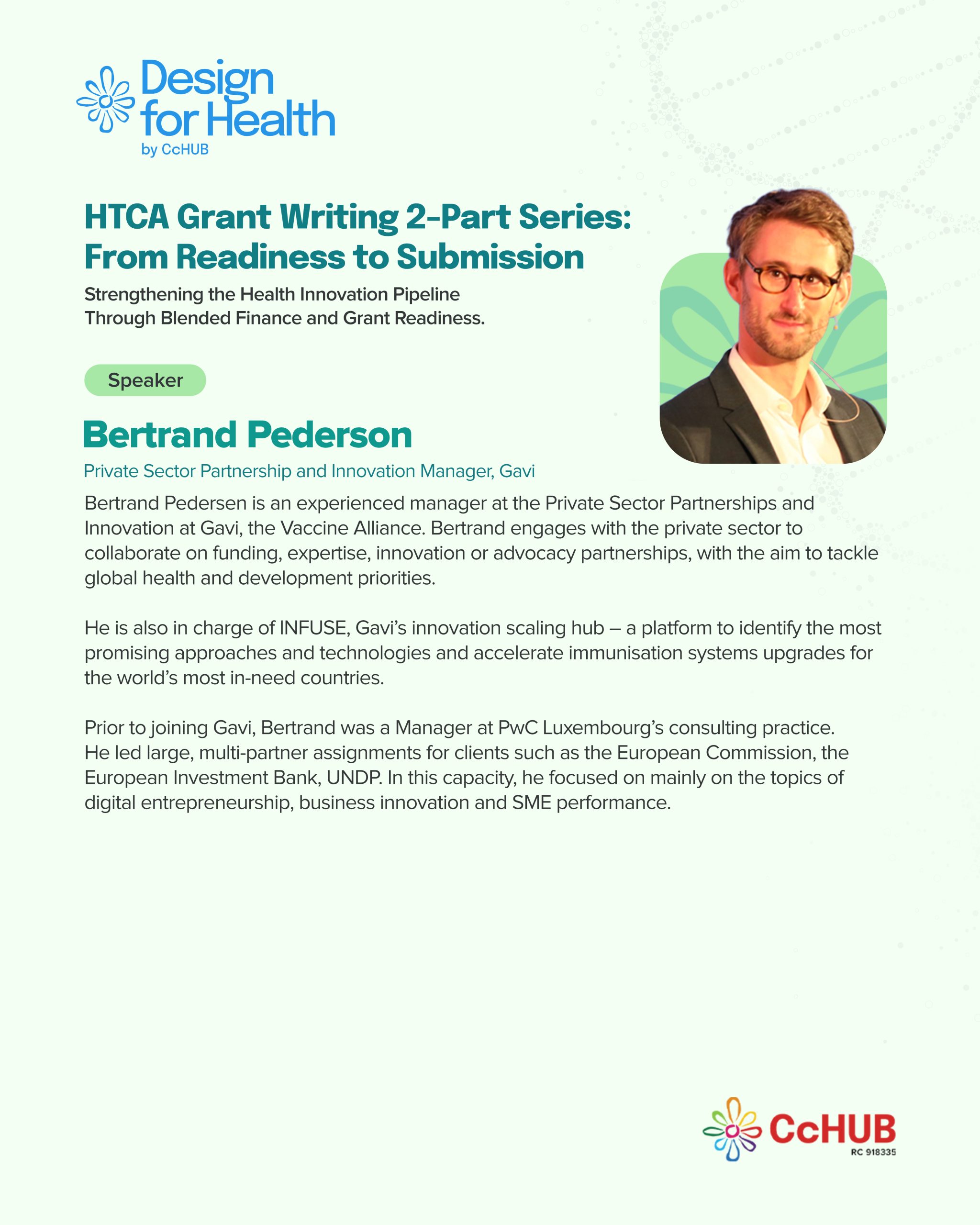
Bertrand works at the intersection of private sector engagement and global health innovation, leading partnerships that mobilise funding, expertise, and innovation to address critical health challenges. He also leads INFUSE, Gavi’s innovation scaling hub, which connects high-potential solutions with partners and countries to accelerate immunisation outcomes in low-resource settings.
Session Focus:
How growth-stage health startups can leverage platforms like INFUSE to access de-risked capital and scale through strategic partnerships.
Ronald Wakhu
Impact Investment Manager, Health Finance Coalition
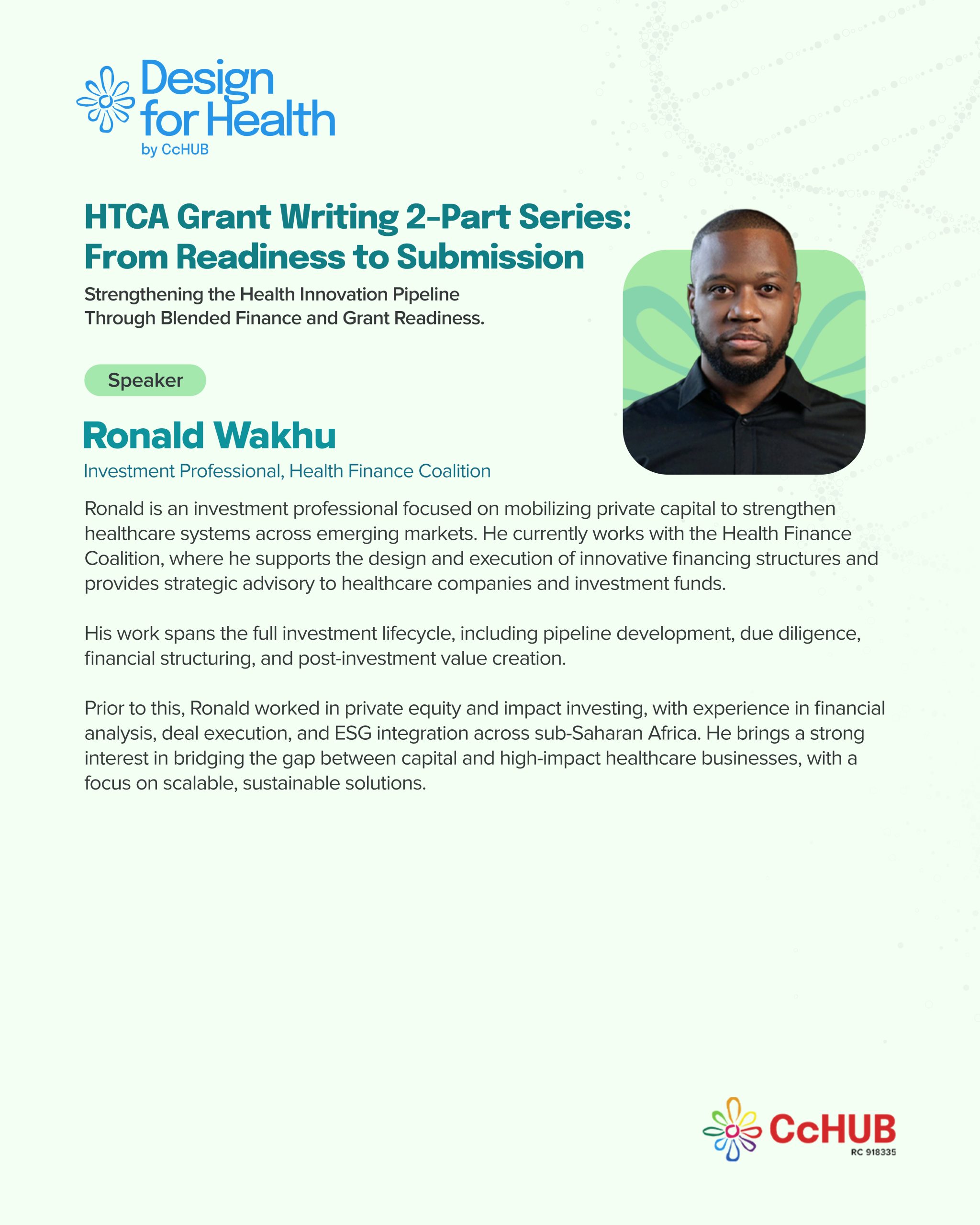
Ronald brings deep experience in structuring and deploying catalytic and blended finance to strengthen health systems. His work focuses on mobilising capital and aligning financing mechanisms to support scalable, high-impact health innovations.
Session Focus:
How blended and catalytic finance are structured in practice—and what founders must demonstrate to de-risk their solutions and transition from grant funding to investment-ready models.
Ibukun Tunde-Oni
CEO, Eight Medical
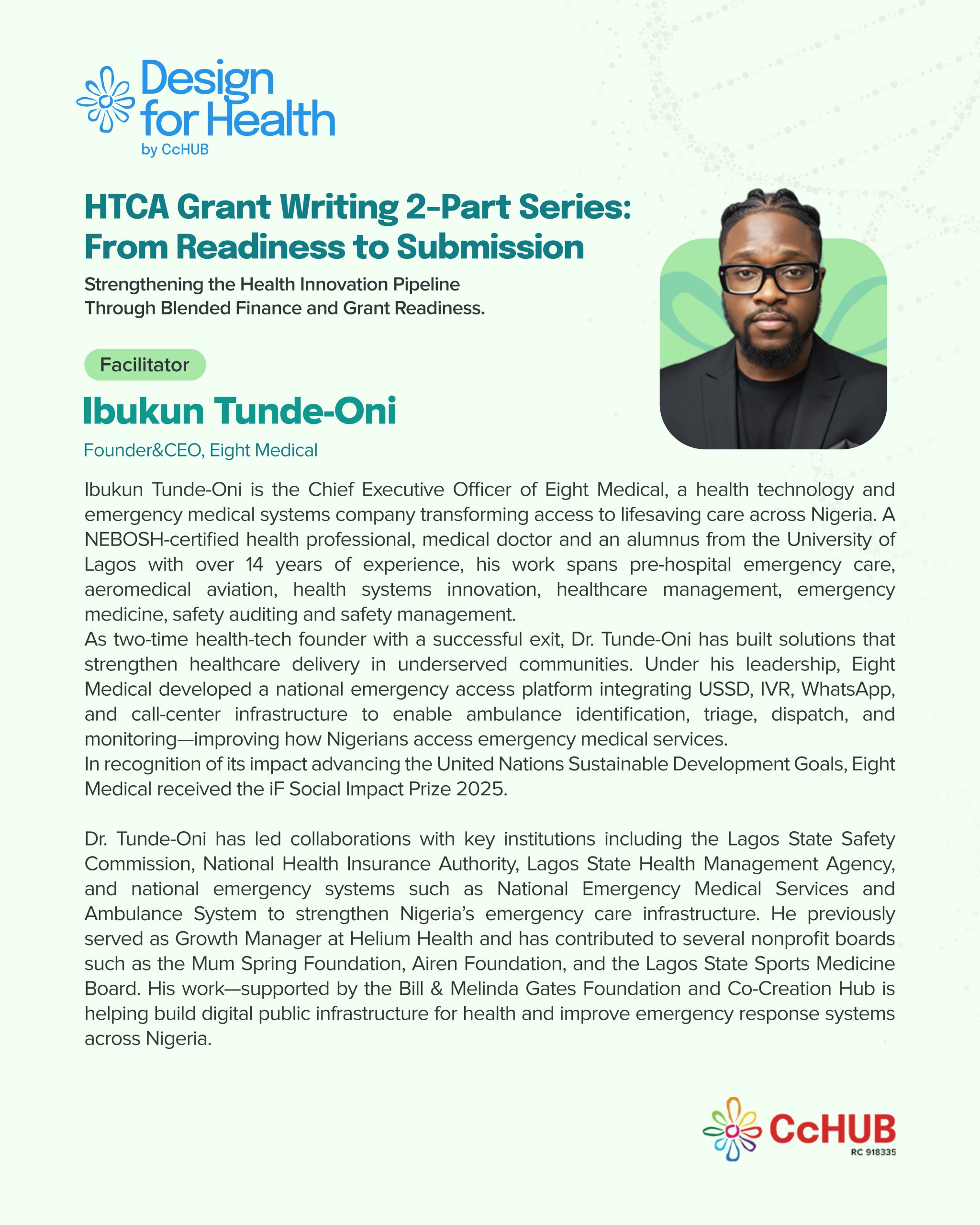
Ibukun is a medical doctor and healthtech entrepreneur with over 14 years of experience across emergency medicine, health systems innovation, and healthcare management. As a two-time founder with a successful exit, he has built solutions that expand access to lifesaving care in underserved communities. Under his leadership, Eight Medical developed a national emergency access platform integrating USSD, IVR, WhatsApp, and call-centre systems to improve ambulance access and emergency response in Nigeria. The company was recognised with the iF Social Impact Prize 2025 for its contribution to advancing the SDGs.
Session Focus:
Hands-on grant writing training for early-stage startups, including how to structure strong applications, articulate impact, and leverage grants as a pathway to partnerships and early funding.
Strategic Rationale
Across emerging markets, health startups frequently encounter what is widely described as the “valley of death”, the high-risk stage between early innovation and sustainable scale. At this stage, founders have proof of concept but lack the structured capital, credibility, and business maturity required to attract institutional investors. This is where blended financing becomes critically important.
Blended finance strategically combines grant capital, concessional funding, catalytic capital, and private investment to de-risk innovation, crowd in investors, and enable startups to transition from validation to scale. In the health sector, particularly in Africa, grants often serve as the first layer of catalytic capital. They enable innovators to:
- Validate clinical or market assumptions
- Strengthen regulatory readiness
- Build early traction and impact evidence
- Develop governance and financial systems
- Demonstrate viability to future investors
Without access to this early-stage, risk-tolerant capital, promising health innovations stagnate. Many startups do not fail due to poor ideas; they fail because they cannot bridge the funding gap between prototype and sustainability.
For platforms like Health Tech Connect Africa (HTCA), improving grant readiness is therefore not simply a skills-building exercise; it is a strategic intervention in the financing pipeline. Strengthening founders’ ability to access grants directly improves their survival, investment readiness, and long-term scalability.
Background
Health Tech Connect Africa (HTCA), hosted by CcHUB’s Design for Health, is a growing pan-African community of health innovators focused on strengthening collaboration, knowledge exchange, and access to opportunities across the digital health ecosystem. As the community continues to expand, a critical need has emerged around improving access to funding, particularly for early- and growth-stage startups navigating increasingly complex financing landscapes.
Despite the proliferation of funding opportunities across global health, many African healthtech startups face persistent barriers in accessing and securing capital. These challenges are not solely due to a lack of innovation, but are often linked to limited grant readiness, weak alignment with funder priorities, and insufficient understanding of how different financing instruments—including grants, concessional capital, and private investment—are structured and deployed.
Grant funding remains a key entry point for early-stage startups, enabling validation of solutions, early market traction, and the development of evidence required for scale. However, as startups grow, access to larger and more flexible capital becomes critical. This is where blended finance models and institutional innovation platforms play an increasingly important role, offering pathways to de-risk investments and support expansion across markets.
In response to these gaps, HTCA is launching the Grant Writing Lab Series as a targeted intervention to strengthen founders’ capacity to access and leverage funding opportunities. The series is designed not only to improve proposal development skills, but also to enhance founders’ understanding of the broader financing ecosystem, positioning them to engage more effectively with funders and unlock pathways to scale.
Event Structure Overview
| Phase | Description | Primary Outcome |
| Phase 1 | Grant Readiness & Fundamentals (Open Lab) | Improved readiness and clarity on grant applicability |
| Phase 2 | Review session | Completed and submitted grant proposals |
Phase 1: Grant Readiness & Fundamentals (Open Session)
Date: April 30th, 2026
Target Audience
- Early and Growth stage healthtech startups within HTCA
- Founders exploring grants as a funding pathway
- Community innovators with limited grant application experience
Format
- Hybrid (Virtual + Limited Physical Attendance)
Core Outputs (Phase 1)
By the end of Phase 1, participants will have:
- Assessed their organisational and startup readiness for grants
- Improve interpretation of funding calls and submission requirements
- Provide exposure to how blended finance and funding ecosystems operate
- Identified at least one grant opportunity aligned with their stage
- Developed an outline of key proposal components
- Expressed interest in progressing to Phase 2 (where eligible)
Phase 2: Proposal Development & Submission Sprint
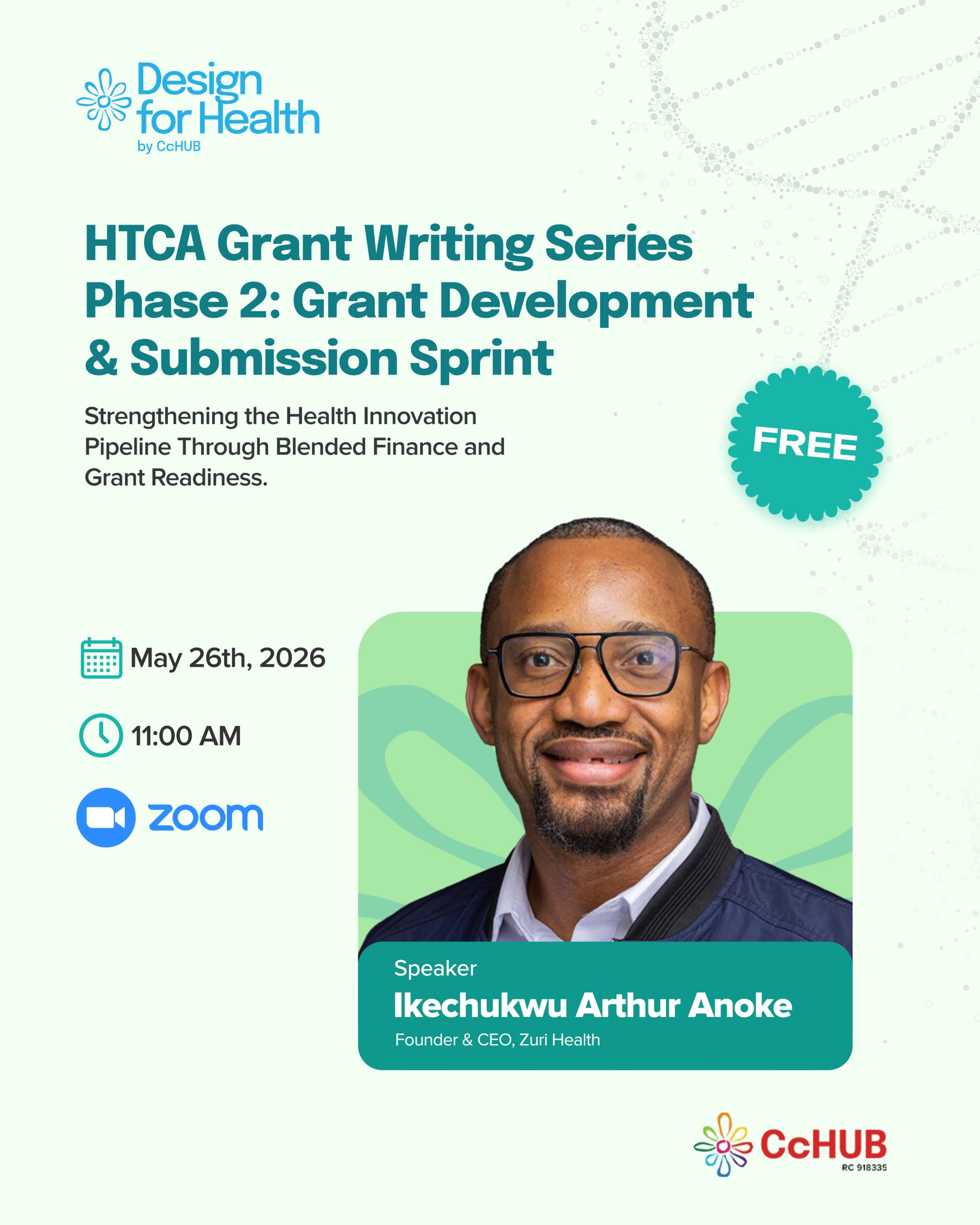
Date: May 26th
Speaker
Ikechukwu Anoke
CEO, Zuri Health
Purpose and Scope
Phase 2 is a closed and focused implementation sprint designed to support selected participants through a guided review to aid in the submission of real grant proposals. This phase is outcome-driven, with submission as the core success metric.
Scope includes:
- Identification and confirmation of 1-2 live grant calls
- A cohort of startups/organisations. ( Innovators may either paired up or submit as a single entity)
- Structured review and iteration support by experienced founders
- Final proposal submission by participating teams
HTCA’s role in Phase 2 is to provide structure and guidance not to act as the applicant, co-applicant, or guarantor of funding success.
Roles and Accountability
HTCA Team
- Programme coordination and timeline management
- Facilitation of peer review session
- Documentation of outputs and learning
Participating Startups:
- Ownership of proposal content and submission
- Timely delivery of drafts and revisions
- Compliance with funder requirements
- Active participation during proposal review
Funding decisions and outcomes remain the sole responsibility of funders.
Selection Criteria for Phase 2
Selection will be based on:
- Clear eligibility and alignment with the selected grant call
- Demonstrated organisational or startup readiness
- Clarity of problem statement and proposed solution
- Capacity to meet timelines and deliverables
- Willingness to engage in feedback and peer learning
- Completion of HTCA Startup needs assessment form
- Completion of Phase 1 event feedback form
Priority may be given to start-ups aligned with DFH/HTCA focus areas and those with limited prior access to grant funding.
Participation Expectations (Phase 2)
Selected participants must:
- Attend all required sessions and check-ins
- Meet agreed submission timelines
- Share drafts for review and feedback
- Take full responsibility for submission processes and compliance
- Participate in post-submission follow-up for impact tracking
Failure to meet expectations may result in removal from the cohort.
Conclusion
The HTCA Grant Writing Series is designed as a practical, outcome-driven intervention that directly responds to a validated community need. By combining broad-based learning with targeted implementation support, HTCA aims to move founders from grant awareness to action, strengthening member’s ability to access funding. It serves as both a high-value intervention for HTCA founders and an enabling platform for healthtech innovation